Modernize legacy apps and infra.
Keep shipping.
Most migrations fail as big-bang rewrites: features freeze, hidden behaviour gets lost, and the new system never catches up. MigrateX moves your frontend (Angular, Ember, Backbone, jQuery) and your backend (Java, Python, Node, COBOL, PHP, RPG) to a modern stack one piece at a time. We show Rust as the example; your backend can land on any modern language. AI does the volume work, our Forward Deployed Engineers guide it with your team, and you keep shipping.
Your application, your infra, or both
Whatever you run today, we move it to a modern stack of your choice, one piece at a time, with the same tests proving nothing changed for your users.
Move one layer, two, or all three. Old and new run side by side the whole way.
See our migration methodology in action
How do you migrate a legacy frontend while existing functionality keeps working? We demonstrate our approach through open source sample applications migrated from Ember, Angular, Backbone, jQuery and Vanilla JavaScript to React.
Each example lets you inspect the original code, the migrated implementation, and the tests used to check behavioral parity.
These are reference implementations built by our team to show the approach. They demonstrate our approach before we apply it to the complexity and constraints of your own codebase.
Explore the apps on GitHubHow an application migration runs
Continuous migration. Seamless for your users. The work is planned around your requirements while customers keep using the product. Hover a step to see where things stand.
Two ways to work with us: hire our engineers to run the migration, or use our plugins and platform with your own team.
- Sign inold
- Feedold
- Articleold
- Commentsold
- Editorold
- Profileold
- Settingsold
- Tagsold
Who does what
Not AI on autopilot. The platform does the volume, and our Forward Deployed Engineers work inside your team: they talk through your goals and constraints with your engineers, then set the strategy, decide the architecture and sign off before anything ships, together with you.
Platform
01
Inventory
Code, services, resources and wiring
03
Porting
Repetitive code, data layers and IaC
05
Parity tests
Run against old and new
Forward Deployed Engineers
02
Strategy
The order pieces move in
04
Architecture
State and edge cases
06
Sign-off
Every piece, before it goes live
Run the migration workflow yourself
Run the full migration workflow yourself in Claude Code, Cursor or GitHub Copilot: inventory, plan, port, prove parity. Frontend plugins are available today; backend and infra plugins are coming soon. Each plugin is MIT-licensed and complete on its own, with no sign-up, license key or usage limit.
The plugins are an open-source project, separate from our migration services. Use them, fork them, or send a pull request on GitHub.
cobuild-tech/cbx-pluginsRuns in your terminal. Claude picks up the migration skill when you ask it to "migrate this app", and the inventory and parity agents run as sub-agents so the main session stays focused on the port.
In Claude Code
/plugin marketplace add cobuild-tech/cbx-plugins
/plugin install ember-to-react@cbx-plugins
Then start with a plan
/ember-to-react:plan
Swap ember-to-react for the plugin that matches your stack.
What's inside every plugin
Migration skill
The full method: assess, choose a strategy, plan, then move one piece per run.
Plan command
Maps the app and writes the plan for your approval. It changes no app code.
Inventory agent
A read-only sweep that lists every route, component, service and piece of hidden wiring.
Parity reviewer
Compares each moved piece with the original and lists every difference in behaviour.
Saved progress
Progress lives in a .migration/ folder in your repo, so work picks up across sessions and teammates.
Live docs
Looks up current framework docs instead of relying on memory.
Pick your starting point
The published plugins target React, the framework we used to prove the method. MigrateX itself can take your code to any modern framework. Ask about other targets.
- EmberReactember-to-reactEmber Classic and Octane apps, full rewrite or incremental
- AngularReactangular-to-reactAngular 2+ and AngularJS 1.x, including hybrid ngUpgrade apps
- BackboneReactbackbone-to-reactBackbone, Marionette, jQuery and Underscore/Handlebars templates
- jQueryReactjquery-to-reactjQuery apps and pages, including jQuery plugins and jQuery UI
- Vanilla JSReactvanillajs-to-reactFrom script-tag pages to ES-module apps
- Published inClaude CodeCursorGitHub Copilot
migratex.cobuildx.ai
Or run it yourself.
The MigrateX platform puts the same agents in your hands. Point it at a repo, approve the plan, review every pull request, with the MigrateX Forward Deployed Engineer Team on hand to work through it with you.
Get MigrateX assessment template
The checklist we use to map every route, service and hidden dependency before a move.
- 01
Connect your git orgs
Link the source repos and a destination org.
- 02
Brief the agent
Describe the move in chat. It proposes a plan and asks before anything destructive.
- 03
Watch it run
Diffs, commands and commits stream into a live console, with full history.
Not ready to talk yet?
Read the playbook.
The whole MigrateX method in one book: what a migration really costs, why most fail, and how to judge any plan put in front of you.
- 13 chapters, 71 pages, written for decision makers
- Based on enterprise apps moved to modern frameworks
- A plan that works for any old framework
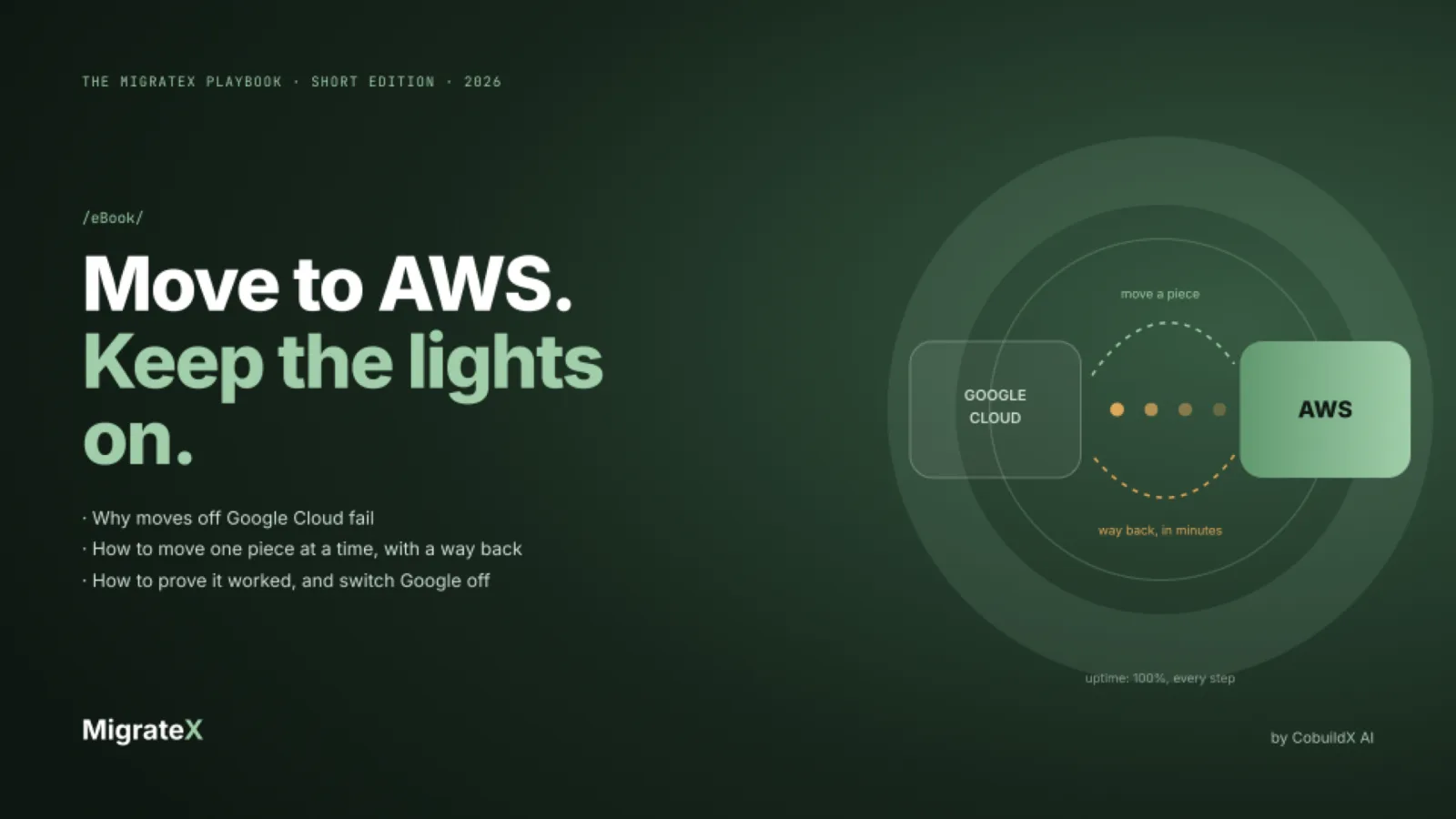
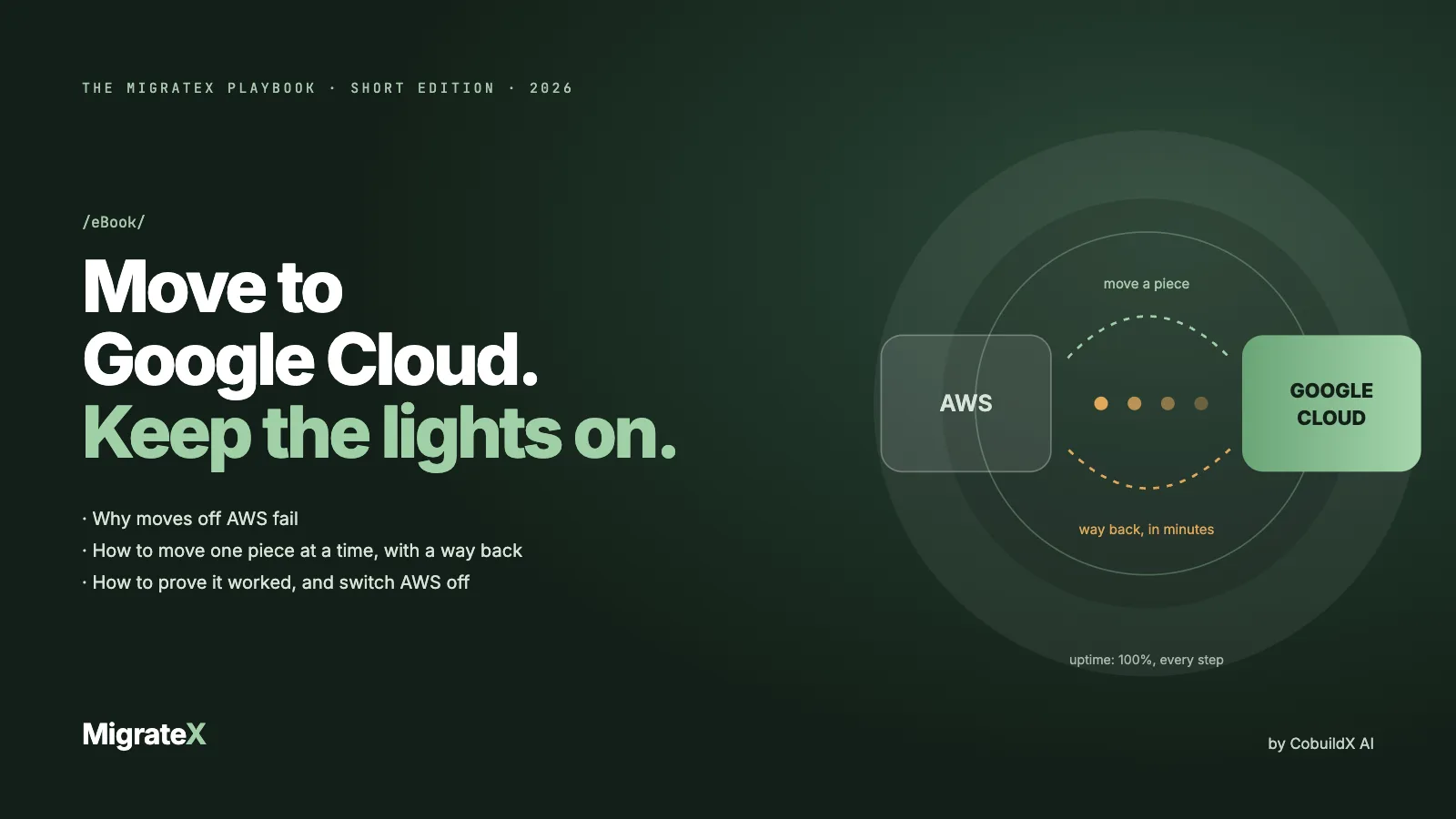
- Bonus: Move to AWS and Move to Google Cloud (Short Editions), sent in the same email
Questions
Plan your application or infra migration with our engineers.Start with an assessment. We map every screen, service and hidden dependency, then give you a timeline based on that.