
The $399 Robot Duck That Teaches Itself to Get Back Up
It waddles, it roller-skates, and when it falls over, it picks itself back up. It also costs less than a video game console.
On August 27, 2026, Hugging Face and its robotics subsidiary Pollen Robotics unveiled Microduck, a 25-centimetre biped robot priced at $399 and shaped, unambiguously, like a duck. Hugging Face had acquired Pollen Robotics in April 2025 specifically to build affordable, open-source AI hardware, and Microduck is the clearest expression yet of that bet.
Underneath the beak, Microduck runs on 15 motors, a camera, a depth sensor, two motion sensors, and an articulated bill that can pick up small objects. It carries 32GB of storage and 1GB of onboard RAM, connects over WiFi and Bluetooth, and ships in four colourways. It can walk, crouch, roller-skate, and, notably, recover from a fall on its own.
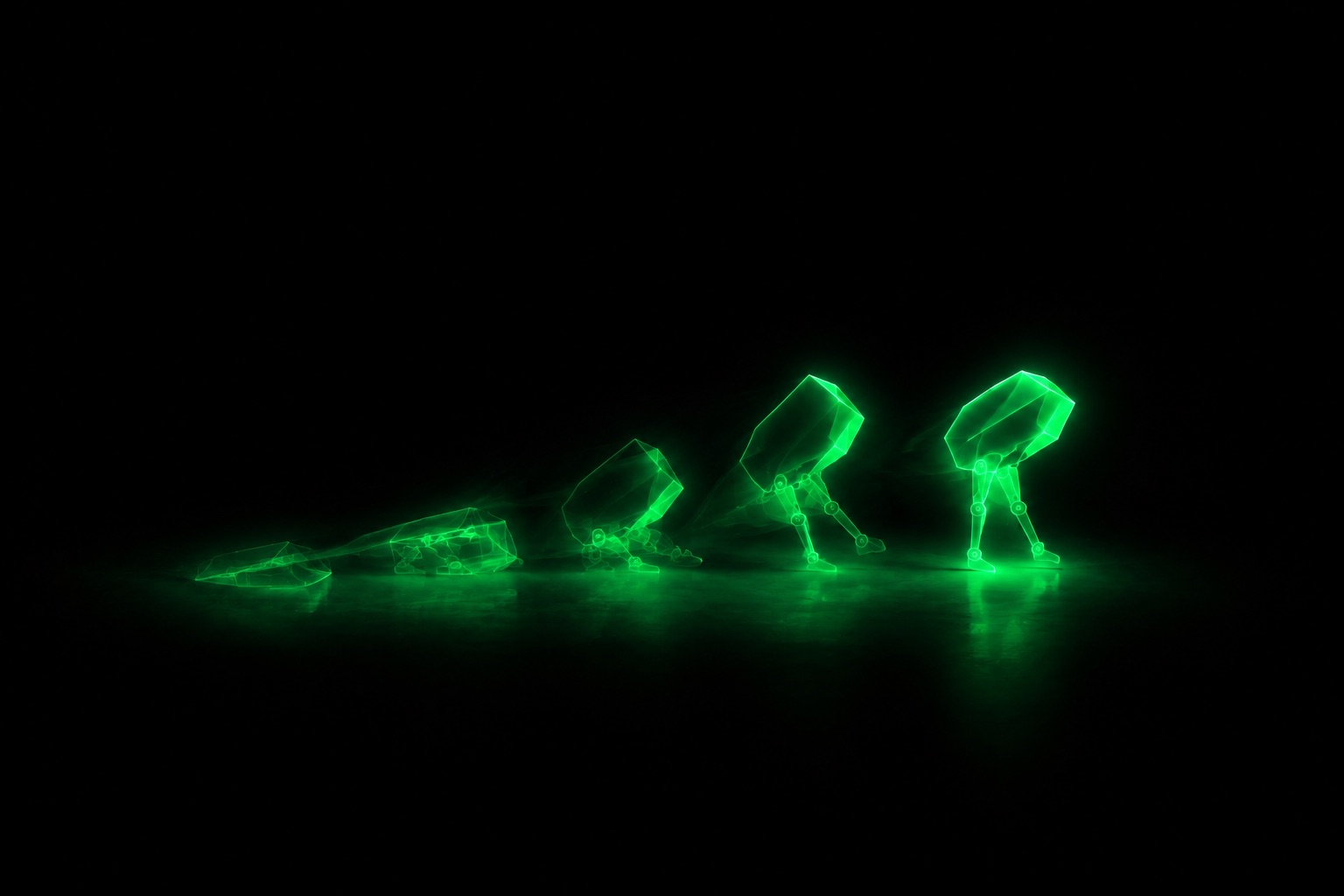
The recovery behaviour is the detail that matters technically. Getting a small biped back onto its feet after a fall is a nontrivial reinforcement-learning problem, one that research labs have spent real budget solving on much more expensive hardware. Hugging Face CEO Clem Delangue described Microduck explicitly as "an open-source robot you can teach new tricks with reinforcement learning," open hardware meant to be a research platform, not just a toy.
Enterprises building AI strategy tend to file "physical AI" and "robotics" under a separate, distant roadmap item from their software agent work. A $399 open-source platform that runs real reinforcement-learning workloads is a sign that gap is closing faster than most roadmaps assume, and the reasoning techniques a team develops for a software agent today may need to generalise to a physical one sooner than planned.
What it actually meant
A $399 open-source biped signals that physical embodiment for AI agents is now a consumer-accessible commodity, not a research-lab exclusive, which changes who gets to experiment with embodied intelligence.
What enterprises get wrong today
Enterprises treat robotics and physical AI as a separate, distant frontier from their software AI investments, missing that the same agentic reasoning and reinforcement-learning techniques now run on both.
Related capabilities
More from Moments
Ask about this story
Hugging Face just released a $399 open-source robot duck that can roller-skate and pick itself up after falling. Want to know how it works, what's inside it, or why a robot duck matters for AI strategy?